Aldeburgh is a coastal town in Suffolk, England, known for its rich cultural heritage and historical significance. It is famous for its association with composer Benjamin Britten and the annual Aldeburgh Festival, which celebrates the arts.
02Geography
Situated on the North Sea coast, Aldeburgh lies just north of the River Alde. The town is characterised by its shingle beach, which is wide in places, allowing fishing boats to land. Aldeburgh is surrounded by the Suffolk Coast and Heaths Area of Outstanding Natural Beauty, featuring several Sites of Special Scientific Interest.
Area of Outstanding Natural Beauty
Suffolk Coast and Heaths
Beach type
Shingle
Blue Flag award year
2005
03History
The name 'Aldeburgh' originates from Old English, meaning 'old fortification'. Historically, it was a significant port in the 16th century, known for shipbuilding, including the Sea Venture. The town's prominence declined as the River Alde silted, but it later developed as a seaside resort.
16th century Aldeburgh gained borough status under Henry VIII.
1948 The Aldeburgh Festival was founded by Benjamin Britten.
1953 Aldeburgh was flooded during the North Sea flood.
Aldeburgh is a coastal town in Suffolk, renowned for its cultural heritage and the Aldeburgh Festival.
04Cultural Significance
Aldeburgh is renowned for its cultural events, particularly the Aldeburgh Festival, which takes place annually at Snape Maltings. The town also hosts a variety of other festivals, including a poetry festival and food festivals, contributing to its vibrant arts scene.
Aldeburgh Festival Founded in 1948 by Benjamin Britten.
Annual Carnival Held in August, featuring a procession and fireworks.
Aldeburgh Literary Festival Organised since 2002 by the Aldeburgh bookshop.
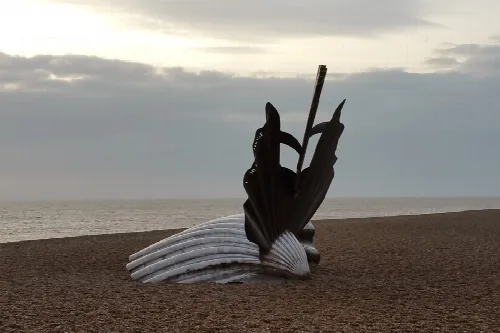
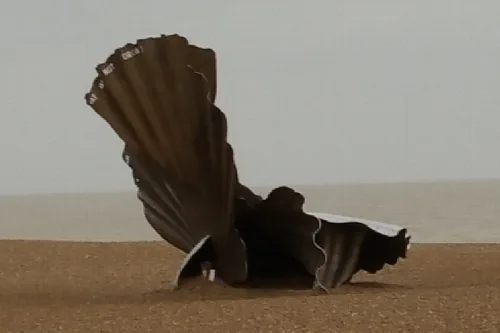
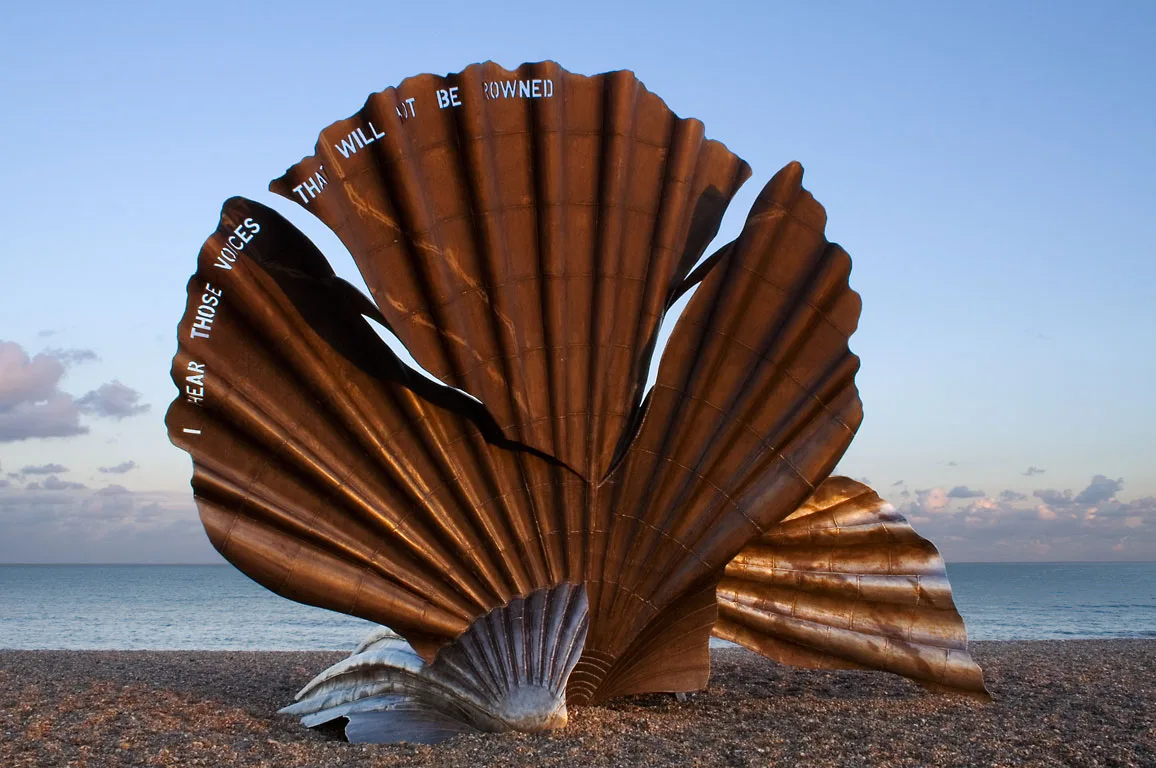
Sculpture of two men in a boat, resembling a scallop, on Aldeburgh beach with the sea and cloudy sky in the background.Scallop sculpture by Maggie Hambling, viewed from the path leaving Aldeburgh towards Thorpeness, resembling a seabird.
05Notable Landmarks
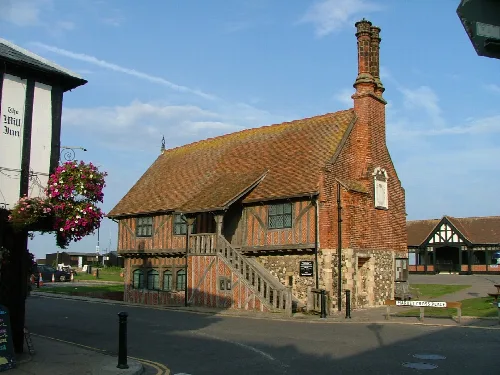
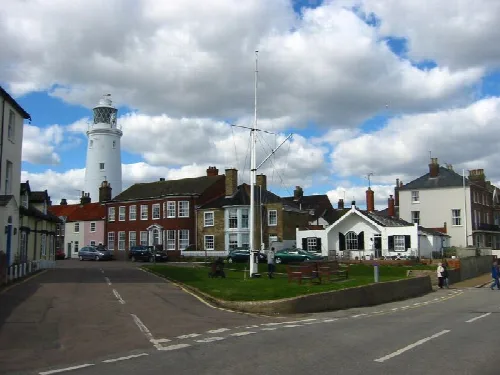
Aldeburgh features several historic buildings and landmarks, including the Grade I listed Moot Hall and a unique Martello Tower, which dates back to the Napoleonic era. The town is also home to the Scallop sculpture, dedicated to Benjamin Britten, located on the beach.
Moot Hall Built around 1520, used for council meetings.
Martello Tower Largest of its kind, now a holiday home.
Scallop sculpture Created by Maggi Hambling, unveiled in 2003.
06Transport and Amenities
Aldeburgh is accessible via the A1094 road, with bus services connecting it to nearby towns. Although the railway station closed in 1966, the nearest station is in Saxmundham, providing links to larger cities. The town offers various amenities, including a library, cinema, and a cottage hospital.
Nearest railway station Saxmundham, approximately seven miles away.
Local radio stations BBC Radio Suffolk, Heart East, and others.
Community radio Alde and Blyth Community Radio (ABC).
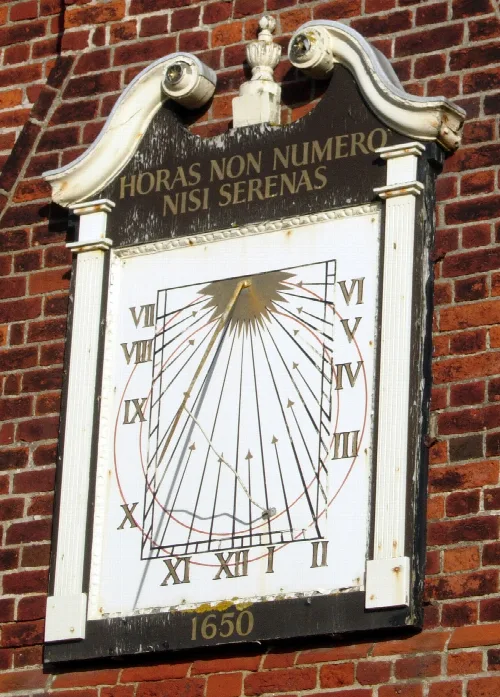
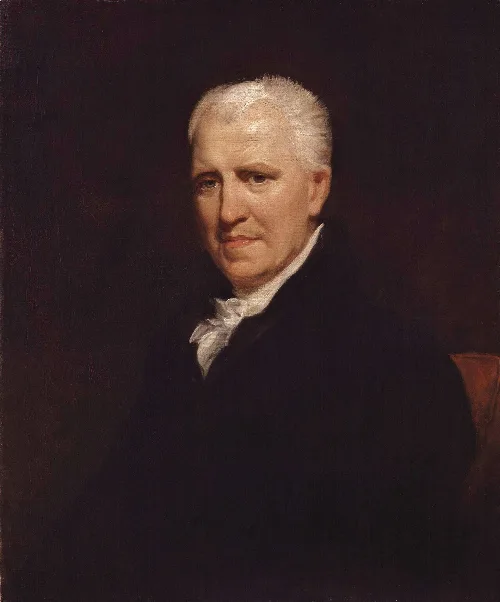
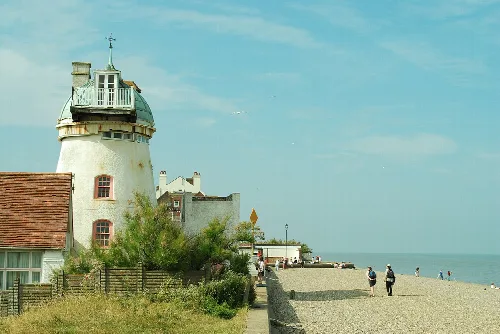
The Moot Hall, a historic timber-framed building with a brick chimney, stands at Market Cross Place in Aldeburgh, Suffolk.Sundial on Moot Hall in Aldeburgh, Suffolk, with Latin inscription and Roman numerals.Portrait of George Crabbe by Henry William Pickersgill, with a dark background and Crabbe in formal attire.A 1900 portrait of Elizabeth Garrett Anderson, an English physician and feminist, in a dark dress with a pearl necklace.A converted windmill turned house in Aldeburgh, Suffolk, with the beach and sea in the background.
Frequently asked questions
What is the large sculpture on Aldeburgh beach?
The large sculpture on Aldeburgh beach is called the Scallop, created by artist Maggi Hambling. It stands 15 feet tall and features two interlocking scallop shells. Unveiled in November 2003, it is dedicated to composer Benjamin Britten and includes the inscription, "I hear those voices that will not be drowned."
What can you tell me about the Moot Hall in Aldeburgh?
The Moot Hall is a historic timber-framed building in Aldeburgh, dating back to around 1520. It has served as a council meeting place for over 400 years and now houses the local museum. The building is Grade I listed and features a distinctive brick chimney and a restored external staircase.
Yes, Aldeburgh hosts several festivals throughout the year. The most notable is the Aldeburgh Festival of arts, founded by composer Benjamin Britten in 1948. Additionally, there is an annual poetry festival and various food festivals that attract both locals and visitors.
What is the significance of the Martello Tower in Aldeburgh?
The Martello Tower in Aldeburgh is a unique quatrefoil structure built between 1808 and 1812 to defend against a potential Napoleonic invasion. It is the largest of 103 such towers in England and is now run by the Landmark Trust as a holiday home, offering a glimpse into the town's military history.
Aldeburgh is known for its line fishing, offering opportunities to catch species such as bass, flounders, sole, dabs, cod, whiting, and eels. However, over-fishing has impacted local fisheries, making sustainable fishing practices increasingly important for the community.
Aldeburgh is home to the Aldeburgh and Thorpeness Rugby Club, which operates at Kings Field. The club has an adult team competing in the Eastern Counties Leagues, as well as youth teams and women's touch rugby, fostering community involvement in the sport.
The Aldeburgh Beach Lookout is a historic Grade II listed tower built around 1830. Initially serving as a lookout for shipping, it now provides an artistic space for residents and tourists, featuring Antony Gormley sculptures and offering stunning views of the North Sea.
Yes, a significant portion of Aldeburgh's housing consists of second homes, making it a popular location for holiday retreats. This trend has influenced the local economy and community dynamics, as many properties are not occupied year-round.
What is the history behind Aldeburgh's fishing industry?
Aldeburgh's fishing industry has a rich history, once thriving as a port with a flourishing shipbuilding sector in the 16th century. Although its port status declined due to siltation, fishing remained vital until the 19th century, when the town also became a seaside resort.
The Aldeburgh Carnival, held annually in August, features a vibrant procession with locals and visitors dressed in homemade costumes. The event includes a parade with Chinese lanterns and a fireworks display, celebrating the community's spirit and creativity.